ELECTRONIC AND ELECTRICAL COMPONENTS

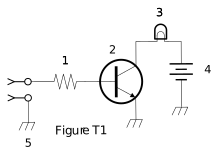
Component 1 is a resistor — the schematic symbol is a short line on each side with a "zig-zag" pattern between them.
In general, a resistor schematic symbol will start with a short line in the center, followed by a diagonal line slanting up to the right and a continued zig-zag pattern for usually 3–4 peaks, with the last one returning to the center line and continuing on.
Schematic symbols are a shorthand to make it easy to recognize components in a circuit diagram; the circuit diagram is a "map" of the circuit.
The other components on the diagram are:
- 2 - NPN transistor
- 3 - Lamp
- 4 - Battery
- 5 - Ground (chassis ground specifically)
Memory aids:
- Think of a Spring = resists when you pull or push
- Resistor symbol = zig-zag line between straight leads
- Think of a circuit diagram as a map showing how components connect
- Reference: Schematic Symbols (http://en.wikipedia.org/wiki/Electronic_symbol)
Last edited by wyatt.roof. Register to edit
Component 2 is a transistor.
A transistor is a control element and has three terminals. The one on the left is called the base. It is the control input and is similar to a small input that controls a larger output. The upper right terminal is the collector and has current flowing into it in proportion to the current into the base multiplied by the gain of the transistor (also called hfe or beta). The lower right terminal has an arrow that indicates the direction the current will flow from both the base and the collector.
Schematic symbols are a shorthand to make it easy to recognize the components in a circuit diagram. The circuit diagram is a "map" of the circuit.
The other components on the diagram are:
- 1 - Resistor
- 3 - Lamp
- 4 - Battery
- 5 - Ground (chassis ground specifically)
Memory aids:
- Think of the base as the control input like a gas pedal: a small action at the base controls a larger current between collector and emitter.
- The transistor has three terminals: base (control), collector (input of the larger current), and emitter (the terminal with the arrow showing current direction).
- Schematic symbols are just a map to show how components connect in a circuit.
Last edited by kd7bbc. Register to edit
Component 3 in figure T-1 is an incandescent lamp. The small looping line drawn inside the lamp symbol represents the filament; when current flows through the filament it heats and emits light.
Last edited by kd7bbc. Register to edit
Component 4 is a battery.
This is the energy source that powers the lamp when a voltage is applied to the input of the circuit. The symbol may show one or more sections indicating the number of cells in the battery pack. The longer line represents the positive terminal while the shorter line is the negative terminal.
Schematic symbols are a shorthand to make it easy to recognize the components in a circuit diagram — the diagram is a "map" of the circuit.
The other components shown on the diagram are:
- 1 - Resistor
- 2 - NPN Transistor
- 3 - Lamp
- 5 - Ground (chassis ground specifically)
Memory aids:
- Longer line = positive terminal; shorter line = negative terminal
- A battery symbol often shows multiple pairs of long and short lines for multiple cells
Last edited by gregor. Register to edit
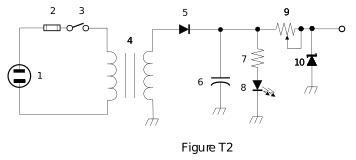
Component 6 is a capacitor. The schematic symbol for a capacitor consists of two conductors (represented by two lines) separated by a gap that represents the insulating material between them. In many drawings one of the lines may be curved to show polarity on polarized capacitors. In that case, the straight line is the positive (+) side. Physically, capacitors are often made by rolling two conductive plates with a dielectric between them into a cylinder, which is why they commonly appear as cylindrical parts in equipment.
Memory aids:
- Each line represents a conductor and the gap represents the insulator (dielectric).
- A curved line is a common way to indicate a polarized capacitor.
- "Curve" starts with C, as does "capacitor."
Last edited by gregor. Register to edit
What is component 8 in figure T-2?
-
Resistor
-
Inductor
-
Regulator IC
-
Correct AnswerLight emitting diode
The symbol for component 8 is a diode symbol (a triangle pointing to a line) with small arrows pointing away from it. That is the standard schematic symbol for a light emitting diode (LED). A diode allows current to flow in one direction (the triangle toward the line); the added arrows indicate that the device emits light, so the component is an LED.
Further reference for common schematic symbols: https://learn.sparkfun.com/tutorials/how-to-read-a-schematic
Last edited by kd7bbc. Register to edit
What is component 9 in figure T-2?
-
Variable capacitor
-
Variable inductor
-
Correct AnswerVariable resistor
-
Variable transformer
A variable resistor is identified by the standard resistor symbol (a jagged zig‑zag line) with an arrow pointing to the middle of the zig‑zag, perpendicular to the body of the resistor. The arrow represents the movable wiper or brush that changes the resistance between the wiper and each end of the resistor as it is adjusted. The two ends of the resistor always represent the total resistance; the resistance from the wiper to either end varies depending on the wiper position.
Memory aids:
- Resistor symbol + arrow = variable resistor (the arrow is the wiper/brush).
- Think “potentiometer” when you see a resistor with an adjustable arrow — it’s how you vary voltage or resistance.
- Reference: electronic component symbols (e.g., the resistor-with-arrow symbol denotes a variable resistor/potentiometer).
Last edited by kd7bbc. Register to edit
What is component 4 in figure T-2?
-
Variable inductor
-
Double-pole switch
-
Potentiometer
-
Correct AnswerTransformer
A transformer is two inductively coupled coils that are magnetically linked but not electrically connected. In the schematic symbol you can see a coil symbol on each side with two parallel lines (the core) between them indicating the magnetic coupling and separation. That identifies the component as a transformer.
Memory aids:
- See a coil on each side with two lines between them — that indicates a transformer (two coils magnetically coupled).
Last edited by kd7bbc. Register to edit
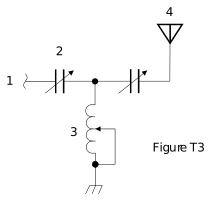
What is component 3 in figure T-3?
-
Connector
-
Meter
-
Variable capacitor
-
Correct AnswerVariable inductor
The symbol for component 3 is a coil (inductor) with an arrow drawn through or alongside it. The arrow indicates an adjustable element (a movable core or tap), which is the standard schematic symbol for a variable inductor.
This differs from a variable capacitor, which is shown as two parallel plates with an arrow indicating adjustment; a meter is usually drawn as a circle with a letter or pointer; and a connector or junction is shown as simple lines or dots.
A list of component schematic symbols can be found here: https://www.radioing.com/hamstart/symbols.html
Memory aids:
- Arrow through a coil = variable inductor
- Arrow to parallel plates = variable capacitor
- Circle with pointer or letter = meter
- Simple dots/lines = connector or junction
Last edited by stvcorrell. Register to edit
The symbol shown is the schematic symbol for an antenna. It is drawn as a triangular shape with one point connected to the circuit and the opposite side open, with a line through the middle. That depiction represents a radiating element (an antenna) rather than a component that is electrically tied to ground or simply a load.
For reference, lists of common schematic symbols can be found here:
Memory aids:
- It visually resembles an antenna or satellite dish.
- Triangle with a connected point and an open side with a center line = antenna.
Last edited by gregor. Register to edit