ELECTRONIC AND ELECTRICAL COMPONENTS

Subelement T6
Section T6D
Component functions: rectifiers, relays, voltage regulators, meters, indicators, integrated circuits, transformers; Resonant circuit; Shielding
Which of the following devices or circuits changes an alternating current into a varying direct current signal?
-
Transformer
-
Correct AnswerRectifier
-
Amplifier
-
Reflector
A rectifier is a component that uses diodes to force current to flow in a single direction. Different modes of rectification produce slightly different waveforms, but all of them take an alternating input and output a direct (pulsating) current. For example, instead of the waveform varying from +140 to 0 to -140 and back, the rectified output varies from +140 to 0 to +140 to 0, with all current flowing in the same direction (the actual voltages are just an example).
A transformer changes the voltage level of a signal (for example from 5 V to 10 V or from 110 V to 12 V). An amplifier increases the magnitude of a signal. A reflector is part of an antenna and is not an electronic circuit that converts AC to DC.
Last edited by kd7bbc. Register to edit
Tags: none
What is a relay?
-
Correct AnswerAn electrically-controlled switch
-
A current-controlled amplifier
-
An inverting amplifier
-
A pass transistor
A relay is an electrically‑controlled switch. It uses a small electrical current to energize an electromagnet (the relay coil) which physically moves contacts to open or close a separate circuit that can carry much higher current or voltage. Relays are commonly used in vehicles and other equipment where a low‑power control signal needs to switch a higher‑power load.
For more detail, see: http://en.wikipedia.org/wiki/Relay
Memory aids:
- A relay lets a low‑power control signal operate a high‑power circuit (think: small coil current operates a big switch).
- Example: a relay coil might need ~100 mA to switch contacts rated for 10 A.
Last edited by zazb. Register to edit
Tags: none
Which of the following is a reason to use shielded wire?
-
To decrease the resistance of DC power connections
-
To increase the current carrying capability of the wire
-
Correct AnswerTo prevent coupling of unwanted signals to or from the wire
-
To reduce receiver overload
A layer of metal enveloping a wire functions as a Faraday cage, which prevents (or at least attenuates) radio-frequency energy being radiated to or from the wire. This shielding minimizes coupling of unwanted signals to or from the conductor, reducing interference to adjacent wiring or equipment and helping preserve the integrity of the signal carried by the shielded wire.
Shielding is about electromagnetic isolation; it does not change the inherent DC resistance of the conductor nor its current-carrying capacity.
Memory aids:
- Think "shielded" = "shield" = blocks RF (Faraday cage).
- Shielding prevents coupling of unwanted signals to/from the wire.
Last edited by rccapps. Register to edit
Tags: none
Which of the following displays an electrical quantity as a numeric value?
-
Potentiometer
-
Transistor
-
Correct AnswerMeter
-
Relay
A meter is a device that measures an electrical quantity and presents the result on a numeric scale or display. Common examples include voltmeters, ammeters, ohmmeters, and signal strength meters — all of which give a numeric reading of the quantity being measured.
A potentiometer is a variable resistor, a transistor is a semiconductor device used for switching or amplification, and a relay is an electrically operated switch. Those components affect or control the flow of current but do not themselves display an electrical quantity as a numeric value.
Memory aids:
- Meter: measures and shows a numeric value (voltmeter, ammeter, ohmmeter, signal-strength meter).
- Potentiometer: variable resistor (adjusts voltage/limit current).
- Transistor: switch/amplifier (controls current flow electronically).
- Relay: electrically controlled switch (uses an electromagnet to open/close contacts).
Last edited by kd7bbc. Register to edit
Tags: none
What type of circuit controls the amount of voltage from a power supply?
-
Correct AnswerRegulator
-
Oscillator
-
Filter
-
Phase inverter
A regulator, often called a voltage regulator, controls (regulates) the output voltage of a power supply so that it stays at a desired level. The exact output voltage and how much current can be supplied depend on the regulator type and any other components in the circuit.
The other circuit types listed do not perform this voltage-control function:
- oscillator — generates an electrical signal (usually a periodic waveform)
- filter — performs signal processing by removing or emphasizing frequency components
- phase inverter — produces two outputs: one identical to the input and one that is phase-inverted (a mirror image)
Last edited by glitteribbon. Register to edit
Tags: none
What component changes 120 V AC power to a lower AC voltage for other uses?
-
Variable capacitor
-
Correct AnswerTransformer
-
Transistor
-
Diode
A "Transformer" is made up of two inductive coils wound around a ferrite core. The primary coil is connected to the voltage source and the secondary coil is connected to the circuit you are powering. The ratio of the number of turns on the primary coil to the secondary coil determines the output voltage.
For example, a 20 : 5 transformer fed 120 V AC will produce 30 V AC on the secondary coil.
Last edited by calsamaus. Register to edit
Tags: none
Which of the following is commonly used as a visual indicator?
-
Correct AnswerLED
-
FET
-
Zener diode
-
All these choices are correct
LED stands for Light Emitting Diode. It is a type of diode (which conducts current primarily in one direction) that produces light when current flows through it, so it is commonly used as a visual indicator. LEDs also tend to have much lower power consumption and longer life than traditional incandescent indicator lamps, which makes them a practical choice for panel indicators, status lights, and similar uses.
Memory aids:
- LED = Light Emitting Diode
- LEDs produce light and use less power than incandescent bulbs
Last edited by qubit. Register to edit
Tags: none
Which of the following is combined with an inductor to make a resonant circuit?
-
Resistor
-
Zener diode
-
Potentiometer
-
Correct AnswerCapacitor
A "tuned circuit" (resonant circuit) is formed by an inductor (L) and a capacitor (C). These two components exchange energy back and forth — the capacitor stores energy in its electric field and the inductor stores energy in its magnetic field — producing oscillations at the circuit's resonant frequency. Such a circuit is commonly called an LC circuit.
The "L" designation for inductance is historically associated with Lenz (as in Lenz's law), who studied induced currents and magnetic effects.
Memory aids:
- "C, I Tuned it." Capacitor + Inductor = Tuned (resonant) circuit.
Last edited by mk2019. Register to edit
Tags: none
What is the name of a device that combines several semiconductors and other components into one package?
-
Transducer
-
Multi-pole relay
-
Correct AnswerIntegrated circuit
-
Transformer
An integrated circuit (IC), commonly called a microchip, is a single packaged device that contains multiple semiconductor devices (such as transistors and diodes) and other components (like resistors and capacitors) interconnected to perform one or more electronic functions. The components are fabricated together on a small piece of semiconductor material and then enclosed in a package so the whole assembly can be used as a single component. Examples range from simple logic chips to complex CPUs and memory devices; nearly every modern circuit board includes ICs.
In schematic diagrams, IC chips are labeled U# (U1, U2, etc.).
Memory aids:
- (none)
Last edited by gregor. Register to edit
Tags: none
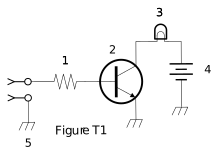
What is the function of component 2 in figure T-1?
-
Give off light when current flows through it
-
Supply electrical energy
-
Correct AnswerControl the flow of current
-
Convert electrical energy into radio waves
Component 2 is an NPN-type bipolar junction transistor (the arrow on the symbol points outward). Transistors have three terminals: two form the main circuit path and the third is a control input. A small current applied at the control terminal controls the larger current between the other two terminals, so the device's function is to control the flow of current. It does not produce light (the lamp is component 3), it is not the power source (the battery is component 4), and nothing in this circuit is converting electrical energy into radio waves.
Memory aids:
- "NPN" → "Not Pointing IN" (arrow points out for NPN)
- Arrow direction on transistor symbols indicates type: arrow out = NPN, arrow in = PNP
Last edited by gregor. Register to edit
Tags: none
Which of the following is a resonant or tuned circuit?
-
Correct AnswerAn inductor and a capacitor in series or parallel
-
A linear voltage regulator
-
A resistor circuit used for reducing standing wave ratio
-
A circuit designed to provide high-fidelity audio
Resonance in an electrical circuit happens when the inductive reactance (XL) and the capacitive reactance (XC) are equal in magnitude but opposite in phase at a particular frequency. When that condition is met the circuit is said to be "tuned" to that frequency and will either pass (series resonance) or reject (parallel resonance) signals near that frequency. An inductor (L) and a capacitor (C) connected in series or in parallel form such a tuned (resonant) circuit. An LC circuit is also known as a tank circuit.
The other items listed are not resonant circuits: a linear voltage regulator controls DC voltage, a resistor network used to reduce SWR is just resistive (it does not produce inductive/capacitive reactance that cancels), and a circuit described only as high-fidelity audio refers to audio quality rather than a specific LC resonance.
Memory aids (if any):
- L + C = tuned/resonant circuit (inductor + capacitor)
Last edited by gregor. Register to edit
Tags: none
HamStudy.org™ is copyright 2026 Signal Stuff™, All rights
reserved.
View Privacy Policy | Get help with HamStudy.org™
View Privacy Policy | Get help with HamStudy.org™